
You can read all installments published so far on this page.
Chapter 32: Trask tries to have dinner at the inn
It should have been Trask’s moment of triumph. He’d been to the belly of the beast and came out alive. He’d found Sidney’s missing editor. He’d traveled further than he’d ever gone before beyond the city limits. And he’d pretty much ruled out both the Baron and the process servers as the people behind the griefing attacks.
He was making progress in the investigation.
Plus, there hadn’t been any more attacks since the Pancake Theater that morning.
So he went back to his favorite place on Krim, the Barley Mow Tavern.
But at the Barley Mow, the innkeeper still wasn’t back to his usual obsequious self.
“You should be grateful I’m allowing you back in,” Quimby said. “Half of my best customers had their heads chopped off. Not that anyone is ever grateful. That would be too much to ask for.”
Trask looked around. “The place is packed.”
“Okay, so maybe we’re getting a few looky-loos,” Quimby admitted. “Everyone wants to see a head get chopped off, never mind that it might be their own. Sometimes, I just don’t understand people.”
Trask glanced at the menu board. “You doubled the prices.”
“You would to, if half your deliveries hadn’t arrived,” Quimby said. “Nobody understands the challenges…”
“I just saw a delivery wagon out front,” Trask interrupted.
“So one got through.” Quimby sighed. “It’s probably the last one we’ll see… and don’t get me started on the personnel issues. Do you know how hard it is to keep staff when there’s a griefer out there?”
“I see you hired two new serving wenches,” Trask said.
Quimby sighed again. “Just out of the gate. Don’t know their ale from their wassail.”
He pointed to the far side of the dining room, where the two new wenches were awkwardly trying to balance serving trays while avoiding bumping into each other. Nearby patrons were watching bowls of hot stew and flagons of tepid ale sliding around on serving trays, and almost, but not quite, falling off.
Oops. One flagon did sail off and Trask watched it narrowly miss a customer’s head, bounce off a table, and spray liquid on everyone in the surrounding seats. One drunk bandit dropped the knife they’d been holding, narrowly missing a wench’s foot. The serving wench jumped back and another flagon fell off her tray.
“I’d take it out of their pay,” Quimby said. “But everyone is enjoying the show so much that they’re leaving extra tips.” He coughed pointedly.
“You want me to tip?”
“Well, you can afford it. I heard you asked for a raise.”
“For a grid with no electronic communications…” Trask began, but Quimby cut him off.
“Yeah, yeah, what a shock, news spreads quickly. Just tell me what you want.”
“I’ll take the overpriced stew and the fourteen-carat bread and the plate of deep-fried skirrets with extra salt,” Trask said, then walked over to the last free barstool. His usual table was occupied by a group of carousing bandits and he could immediately tell that they were too drunk to try to reason with by the fact that they were trying to eat peas off their daggers. No, he didn’t want to ask them to move. There was no point in arguing with a drunk person holding a giant knife.
The sound of metal hitting metal came from the other side of the room. Two patrons were having a mock knife-fight. A knife flew through their air from a different direction, past Quimby’s head, and embedded itself into the menu on wall on the other side of the bar. “Barkeep! Your finest ale!” someone yelled.
Quimby ignored them.
“And the plate better be made of gold,” Trask told the innkeeper as he sat on the barstool. “Also, your finest house ale and some of those wet suckets again for dessert. I really liked them last time. My compliments to the chef.”
Quimby held out his hand.
“What, you want me to pay first?”
Trask glanced around to make sure nobody was watching him then pulled his third-best purse out from under his third-best jerkin. The second-bests had been stolen at the newspaper fire, and the first-best were being saved for a special occasion. How much was the meal? Trask tried to add up the prices in his head and wished, once again, that the grid owners hadn’t decided to use historically-accurate shillings, pence, groats, mites, and crowns. Krim had so many medieval-themed rules that even he had to admit sometimes that it was a little too much. Most were observed only when grid administrators were around, like wearing period-appropriate clothing around tourists, not mentioning real-world current events around tourists, only speaking Krimmish around tourists… He glanced around again. There were a lot of tourists. The wench who’d just squeezed in next to him was definitely a tourist. Fresh out of the gate, by the looks of her. Barely any dust on her frock.
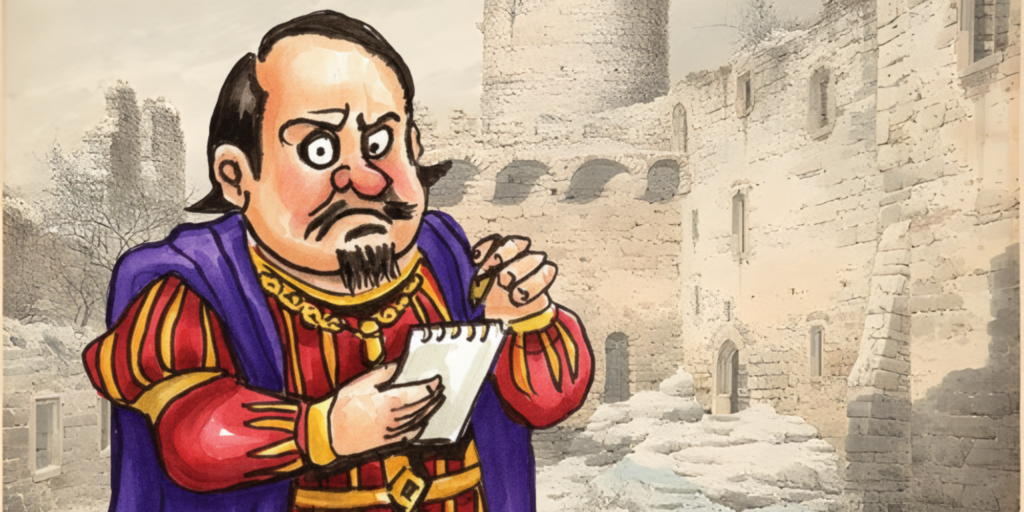
Trask pulled out his third-best notepad and period-inappropriate pencil, hid the purse back under his jerkin, and told Quimby, “See ye not the tourists listening? Yet ye speak not in proper manner within the enforcement zone. There be a fine for that, as ye know.”
“Of course there is,” Quimby said, shaking his head.
“The language ordinance,” Trask said, tapping his pencil on the notepad for emphasis. The pencil slipped out of his hand and he bent down to pick it up just as something cold and metallic brushed his neck and hit his livery collar. The metal thing fell to the stone floor with a clang and Trask saw that it was a knife. It was a good thing he wasn’t wearing his ruff collar, he thought. The knife could have damaged the fabric. He scooped up the pencil and the knife and straightened up.
“Oops,” said a woman’s voice.
“Didst thou let fall this blade, good wench?” Trask asked the woman standing behind him. “Have a care, for these implements be most sharp and perilous. It could have caused some person injury.” He switched the knife to his other hand, holding it by the blade, and handed it to her hilt-first.
“Sorry, someone bumped me,” she said.
“‘Tis of naught,” Trask said. After the assassination attempts yesterday, the mob with the severed heads this morning, and being nearly killed by the Baron in the afternoon, a little accidental nick was the least of his worries.
No, he had much bigger things to think about.
Like, where did Quimby go? Trask looked around, then slid off his stool and followed the man back to the front desk.
“By ordinance most clear, all merchants and innkeepers within the tourist precinct must employ speech befitting our time when visitors from distant lands be present,” he said.
“What ordinance?” Quimby said, finally turning around.
“These rules were set forth in thy membership charter from the Chamber,” said Trask. He knew that most people didn’t bother saving them. Varmint and mold-proof filing cabinets were expensive and paper made perfect kindling.
Quimby glanced at the large fireplace set into the wall between the dining room and the kitchen and Trask knew he’d guessed right.
“Where exactly is the edge of this tourist zone?” Quimby whispered.
“I believe that falls under the category of legal advice,” Trask whispered back. “I’d have to consult our attorney about whether I’m allowed to comment.”
“You’ve got to be kidding me. And, anyway, I don’t see any tourists.”
Trask glanced around the dining room. Several patrons wore T-shirts that said “I Got Beheaded on Krim” in bold letters.
“They might not be tourists,” said Quimby. “Maybe they’re wearing the shirts ironically.”
“I could ask,” said Trask, then pointed at the serving staff. “But you yourself said that those two wenches were fresh through the gate.”
“They’re employees!” Quimby protested. “That makes them residents!”
“Have they been paid yet?” Trask asked.
“Well, no, but—”
“And have they spent at least forty-eight continuous hours on the grid?”
Trask turned his notepad to a fresh page and looked up at Quimby, pencil at the ready. He could see the innkeeper’s brow furrow as the man quickly ran some calculations. By Trask’s estimation, straightening this out would cost Quimby many hours in chamber meetings, steep legal fees, and, at the end of it all, the man might still end up having to pay the fines. Bureaucracy was a feckless beast and Trask was its master.
He was looking forward to the fight.
Quimby must have recognized Trask’s eagerness. “I said nothing of the sort. You must have misconstrued—” He glanced back at the T-shirt wearers. “Thou must have misconstrueth, my lord.”
Trask tapped his pencil. “And?”
“And the meal is on the house.” Quimby stopped and thought. “I mean, it shall cost thee naught.” He paused again. “But eat with haste, ere the Baron doth murder thee. I do hear he be returned to the city…”
Trask lowered his pencil. “What?”
“Are you done torturing me with the Krimmish?” Quimby asked. “I’ve suffered enough today..”
“Just tell me about the Baron.” When Quimby didn’t respond immediately, Trask put away his pencil and notepad, and the man opened up.
“Word is, he and Margrave Ademar came tearing back into the city this afternoon,” Quimby said.
“You could have mentioned that earlier,” said Trask, his appetite suddenly gone. “But why?” Was he chasing his escaped prisoners? Or upset that Trask didn’t turn around and go back, and Matilda killed one of his men? Or it could be something else entirely.
“It’s just what I heard,” Quimby said. “I was a little busy to ask a lot of questions. Not that people would have bothered to explain things to me.”
“I know why you’re in the Baron’s ill graces,” said Taenaran the Bard from his usual table. “It seems his recruitment drive didn’t go so well. Half of the potential soldiers got their heads chopped off yesterday.
“Also, I heard that you took some prisoners away from him,” Quimby added. “The Baron hates that.”
“That’s not true,” Trask said.
“I heard from a scribe over in the scriptorium that your bold rescue of Sidney’s editor is going to be on the front page tomorrow,” said Taenaran.
“I didn’t…” Trask began, but the bard sang a couple of warm-up notes, then launched into a ballad.
“What Cyril saw ere darkness fell was Marshall Trask, that hero bright, who charged into the dungeon deep with stalwart souls prepared to fight,” Taenaran warbled.
How did the bard know what Cyril saw? Did he get in touch with Cyril off-world? Or was he just making stuff up? Or did Sidney leave Krim and talk to Cyril? Maybe Cyril finally finished that article he was writing, and Taenaran’s scribe read it early.
Cyril must have returned Sidney’s messages when he was back in the real world, Trask thought. Maybe Cyril didn’t remember that the Baron was the one who sliced his throat because it was so traumatic and gave Trask credit for saving him from further torture. Trask had never killed anyone, well, not since games had become so hyper realistic. It was one thing to kill a cartoon avatar in a painless environment. It was something else entirely to inflict actual pain on another human.
Taenaran continued with his ballad, providing a completely inaccurate account of Trask releasing the rest of the Baron’s prisoners, then facing down his entire army before riding back to the city victorious.
The Baron wouldn’t like that ballad at all, Trask thought. But the inn’s patrons did. They applauded when Taenaran was finished, and someone even bought Trask a drink.
“For he’s a jolly good fellow,” one drunk bandit belted out, and soon the other drunk bandit joined in. “For he’s a jolly good fe-e-e-llo-o-o-o-w…”
Even the wench who’d nearly nicked him with her knife slid over to him and smiled. He thought she was about to say something flirtatious when the front door slammed open and two delivery drivers stomped in.
“That was our last run of the night!” one proclaimed.
The drunk bandits stopped singing Trask’s praises and turned towards the teamsters.
“Like a few arrows would have stopped us!” said his fellow driver.
“For Emma!” said the first.
“Their drinks are on us,” said one of the drunk bandits.
The drivers swaggered to the bar.
“What about the Humanist blockade?” someone asked.
“Oh, yeah,” said a driver. “Some protesters tried to block the West Upping Street bridge and we threw them all into the river.” He wiped his hands. “Problem solved. We won’t be seeing those folks again for at least a couple of weeks.”
“Maybe never, if they know what’s good for them,” said the other driver. “It’s one thing to peacefully assemble in front of City Hall. But blocking traffic….”
If the Humanists were gone, that left one major suspect to worry about, Trask thought. His predecessor at the Chamber.
He left the wench, to her obvious disappointment, and walked over to Taenaran’s table.
“If I could have a word with you later about some of the details in that ballad,” he began, but the bard cut him off.
“Poetic license, my good man. Poetic license.”
“Well, then, maybe you could help me with something else. Any chance you know what Vorgath Steelhand is up to?”
“The guy who tried to take over the city?” Taenaran asked. “Sure. He and his flunky, Grimnar, are in Gegorport, working security.”
Gegorport was a few day’s travel north of Krim City. Vorgath would have a hard time coordinating a griefing campaign from that far away. Trask would have heard about it if they’d come back. He took out his notepad and wrote down a note to take them down off the murder board. Or, at least, move them down to the bottom.
“You’re planning to take them on as well?” the bard asked. “Are you on a mission to clean up all of Krim?”
“No, no, of course not,” said Trask. “Just curious.”
“Then why did you write it down?”
“Never mind,” he said. “I’ve got to go.”
He needed to get back to the Chamber, he thought. Osgar would want to know that deliveries had resumed, and he would also know what to do about the Baron.
Trask glanced at the front windows of the inn. It was dark outside, and he couldn’t see anything. The Baron and his fighters could be out there. He’d better use the back door.