
You can read all installments published so far on this page.
Chapter 11: The scent of victory
Banking Street this close to the central plaza was a key retail location and everything in the perfumerie was vastly overpriced.
Trask could think of half a dozen places in Krim City where he could get better deals. He didn’t mind paying well for quality goods but he had an objection to spending too much money on tourist junk.
And most of the shop was filled with tourist junk. Tiny sachets of herbs that were one percent the good, expensive stuff and nine-nine percent common mint. And the stitching was subpar as well — he could see loose threads and unfinished seams. He moved past the exhibits at the front of the store to the shelves at the back, occasionally glancing out the front window to see if the Baron and his troops had moved on yet. What was holding them up? The Baron seemed to be in an argument with someone Trask didn’t recognize. No, the woman moved her head and Trask realized that she was one of the major landowners on Krim. If they were discussing land issues, the discussion could go on for a long time.
He considered leaving the shop and trying to sneak by them but then the Baron glanced up and Trask immediately looked back down at the shelf in front of him.
The row of pomanders caught his eye. Not the heart-shaped ones but the little perforated balls of metal. People filled them with herbs and scented oils and hung them around their necks, or carried them in their pockets. There were gold ones, silver ones, and one of brass, tarnished, like his badge. If he got it, then got a third item with a similar finish, like a clasp for his robe, then it would be an intentional design choice rather than a mistake. He could be deliberately going for that antique look.
He picked up the tarnished brass pomander and turned it around in his hand.
“How much is this?” he asked.
“Half a shilling, one groat, and three farthings, kind sir,” the shopkeeper answered in the fake King’s English style the grid’s merchants were required to use with visitors.
Trask glanced up and glared at the shopkeeper. “Do you take checks?”
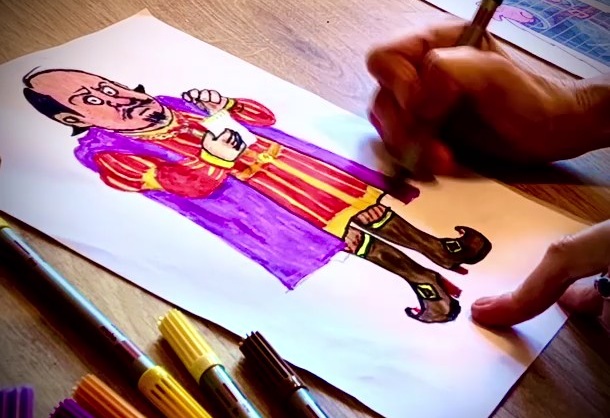
“Oh, I’m sorry, I didn’t recognize you at first,” the shopkeeper said. “I thought you were a tourist in a King Henry the Eighth costume.” She gestured at the window. “What’s going on out there? Is the Baron going after that griefer?”
“The griefer’s already dead,” Trask said. He’d been waiting for someone to ask him ever since he left the alley. “Joe and I just disposed of the body.” He patted the process server’s briefcase. “And I’m about to neutralize another major threat to the grid.”
Maybe the Baron had a big army and people wet their pants when they saw him coming, but Trask was the one who was responsible for the griefer’s body being found and he was the one with his hands on a briefcase full of subpoenas. He was making the world a better place for its residents, while the Baron… well, Trask didn’t really know what the Baron was doing. He got a lot of people killed, and was always going off to one war or the other, but these wars didn’t seem to be making much of a difference to anybody.
The shopkeeper looked up at him. “You’re that new Chamber security chief, right?”
“I am,” Trask said, and patted his badge. “On the job for three months.” He smiled and waited for her to commend him on his work.
Instead, she launched into a litany of complaints about zoning issues and import licenses.
“Yes, yes, the Chamber is aware of all that and is working on it,” Trask interrupted. He held up the pomander again. “What’s the price if I pay by bank check?”
Trask didn’t carry metal coins.
Few Krim residents did. Coins were heavy and easy to steal. Plus, the official denominations were incomprehensible. As a result, only tourists carried cash.
Residents carried checkbooks, which, strictly speaking, did not exist in England in the year 1500. Or they paid their bills at the bank, via direct transfer. This was why, once a month, Trask asked Quimby for a statement of accounts, so that he could go to the bank and settle it, and Quimby would laugh and say that all the meals were on the house because of what a benefit it was to have the chief of security frequenting his establishment.
“Four ninety-five,” the shopkeeper said.
“It’s tarnished,” said Trask.
“Yes, that’s why it’s only five dollars,” said the shopkeeper. “I mean, five arbitrary bank units.”
All real transactions were denominated in so-called arbitrary banking units since the word “dollar” was strictly prohibited on the grid. Any mention of modern payments or modern technology was an immediate terms of service violation, though enforced more in theory than in practice.
“But we also sell polishing paste.” She reached down behind the counter and took out a small jar of Benny’s Own. “Seven ninety-five.”
“That’s more than the pomander,” said Trask.
“But you can also use it for other things. Like your sword.” The shopkeeper glanced down at Trask’s waist, which was sword-less. “Or maybe your badge. It’s looking a little tarnished.”
Trask clasped his badge. He’d spent hours trying to make it shine and was getting a little defensive about it. “I’ve tried that brand before and it doesn’t work,” he said. “I’ll just take the pomander.”
“And what scents would you like to fill it with? We’ve got…”
Chapter 12: Protesters proclaim the end is nigh
The entrance to City Hall was blocked by half a dozen protesters, wearing white robes, carrying signs.
The robes were probably historically inaccurate, Trask thought. He couldn’t even remember seeing them in the avatar catalog. No, wait. In the religious section, after monks and friars, there were cult accessories. Krim had a lot of cults. Sex cults. Death cults. Apocalyptic cults. They were a big tourist draw.
At first, Trask thought this group was part of an apocalyptic cult, drumming up members. A couple of them were holding signs–written in coal on wooden boards, cardboard not yet having been invented–with the word “repent” in all capital letters.
But then as he got closer he could make out the scrawls on the other signs, including “leave the devil’s playground” and “cancel your life insurance.” As far as he knew, no Krim cult was opposed to life insurance. These cultists weren’t endemic to Krim. If they were who he thought they were, they were opposed to the very idea of Krim.
The locals gave them a wide berth but the tourists thought they were part of the show and posed for pictures. Several sketch artists had set up easels.
“Krim’s a sin! Don’t log in!” a protester yelled, and the rest picked up the chant.
They’re definitely Humanists, Trask thought.
The Humanists were opposed to all virtual worlds on the principle that God created Adam and Eve out of flesh and blood, not bits and bytes.
They also believed that if someone died in real life, in the physical world, and was brought back, they weren’t themselves anymore. Their soul had moved on to the afterlife, and the resurrected person was just a hollow shell, or AI, or a demon pretending to be human. They weren’t necessarily consistent.
Trask didn’t feel like the spawn of Satan. But then again, that was what a demon would say.
The protesters switched to a different chant: “Go home! Save your soul!”
Trask walked between two of the street artists documenting the protest. “Hello, Henry. Hello, Thomasin.”
Henry grabbed at his easel as Trask went past, which Trask thought was a little disrespectful. He wasn’t some big lumbering ox who knocked things over whenever he walked past. Though his robe was a little on the wide side, he had to admit. He tried to give Thomasin a slightly wider berth, and she didn’t grab for her easel, but she did hold down a stack of sketches on heavy paper. The top one was a drawing of the protesters. Judging by the height of the stack, she’d been hard at work all day. He wondered if he was in any of the sketches.
She saw him looking. “See anything you like? The afternoon light diffusing through the clouds is particularly gentle today. It gives the crazy people that soft, ethereal glow.”
Trask glanced at the sketch she was working on. The idea of perspective had been invented in the fourteen hundreds, but the news didn’t seem to have reached Thomasin yet.
“Do you have any sketches of me?” Thomasin’s art might not have done him justice, but he liked to encourage local creators.
“Not today, but I’ve got more back at the studio,” she handed him a small card with her name and address handwritten on one side and a little map of the art quarter on the other. He glanced at the card only long enough to confirm that she was still on Plague Alley, then handed it back. Card stock was expensive.
Thomasin glanced around and leaned towards him. “I’ve heard there’s a griefer going after tourists, merchants–and creators,” she said, in a low voice. “Is this true?”
The other artist was close enough to hear and looked over in interest.
“There was,” Trask said. “But he’s dead.” Trask tapped his badge. “I’ve just come from disposing of the body.”
Thomasin’s face lit up and Henry gave a loud sigh of relief.
“That is fantastic news,” Thomasin said, tentatively touching Trask’s arm. “It’s so wonderful that Krim finally has someone who takes safety seriously. I’d hate to start having to lock the doors of my studio. I want the public to be able to enjoy my art.”
“And they still can,” Trask assured her.
He started walking away when one of the tourists noticed him.
“Ooh! Can I get a…”
“No,” said Trask. He had places to go and things to do. He didn’t have time to stand around and pose for portraits. “Well, maybe after I’m done at City Hall,” he added. There was no reason to be rude.
The tourist stepped aside to let him pass but the protesters saw him and closed in.
One of them waved a handout in Trask’s face. “Did you know that they’re now bringing people back who died in the fifties? The nineteen fifties? The same people who almost destroyed the world with nuclear bombs!”
“I thought you didn’t believe that they were people,” Trask said and immediately regretted it. Trying to have a conversation with a Humanist was like talking to a rock.
“That makes it even worse!” the protester insisted. “They’re demons with the memories of the people who almost blew up the world. They can’t be allowed to walk among us.”
“Or vote!” said another protester.
“Or take our jobs!”
Trask suspected that someone who died in the 1950s and brought back to life nearly two hundred years later would have other things on their mind than becoming a protester for the Humanists.
“And are they really selling fried rats over there?” One of the protesters pointed back at the Central Square.
“I never had fried rat,” another protester said thoughtfully before both he and his neighbor were shushed by the rest of the group.
“Well, I’m hungry,” he said under his breath.
“We’re shutting Krim down!” a protester yelled almost directly into Trask’s ear as he pushed past them towards the City Hall steps.
Did the have something against Krim in particular?
“We’re shutting down all the virtual worlds!” yelled another protester.
Well, that made more sense.
“But we’re starting with Krim first!”
Trask opened the City Hall door and went inside, chants of “We will end you!” echoing behind him.
Awesome writing, Maria! So witty and well-thought out!
Awesome writing, Maria! So witty and well-thought-out!