
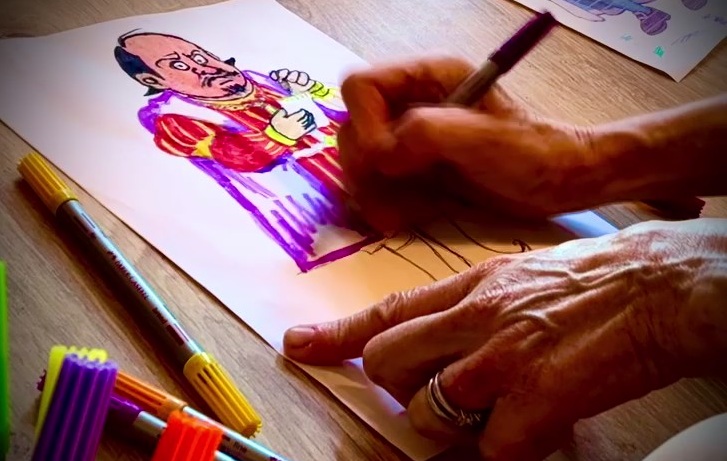
You can read all installments published so far on this page.
Chapter 33: Trask and the wench
The alley behind the Barley Mow was dark and damp. Trask had to feel his way along by keeping a hand on the stone wall of the inn.
The alley continued all the way down to Banking Street, running behind the buildings that lined Leadenthall. His steps echoed from the stone walls in that weird way that made it sound like someone was walking behind him. But when he stopped to listen, it was quiet. Quiet except for the usual sounds—the rustling of rats, the yelling of the wagon drivers in the street at the end of the alley, the banging as someone dropped something down a trash chute. And a splashing sound as someone emptied a bucket of water from a window above, narrowly missing him. At least, he hoped it was water.
He started moving again, a little faster, swearing when he stubbed his foot on a jutting rock and then ran into the side of a building that inexplicably jutted out. But there were lights up ahead on Banking Street, and he soon started being able to make out shadows.
He walked faster, almost jogging, until he got to the end of the alley and looked out. All he could see was the usual traffic. No sign of the Baron and his army. He crossed in the middle of the street, narrowly avoiding being run over by a mule, and turned towards the chamber building.
Joe and Matilda might be there already, back from their patrols of the other commercial areas on Krim. Or he could just keep walking north. The central square wasn’t that much further. He could go out through the gate and hang out somewhere safe until the Baron got tired of looking for him and went off to fight his war. He could go to Facepage, eat some French Fries, catch up on his mail…
Instead, he stopped when he got to the front of the chamber building, looked around, then climbed up the steps and went inside.
Matilda was cleaning her knives and Joe leaned against the wall, watching her.
“You’re back,” she said. “We just got done and were about to go find you.”
“We had to kill a few people,” said Joe.
“Because they kept bringing us heads and we were tired of the paperwork,” said Matilda.
“It was mostly her who did the killing,” Joe added.
Matilda held up a knife and checked her reflection in it. “I may have gotten a little enthusiastic.” She turned to Joe. “How much blood do I have on me, really?”
“You look fine,” he said.
Trask cleared his throat. Matilda’s face, hands, and hair were splattered with blood, and her clothes probably were as well, though it was hard to tell because she wore all black. But he decided not to mention it. “Is there a way to barricade the door? I heard a rumor the Baron is looking for me.”
“Oh, yeah, he’s already here,” said Joe.
Matilda pointed at Osgar’s office door then stashed her knife.
No, he was not going to go there.
He backed up until he felt the door handle behind him, opened it, and slipped back outside the Chamber building. He shut the door gently, turned around, and started down the stairs.
“Yoo hoo, Marshall Trask,” a woman’s voice called out.
Startled, Trask stopped and looked around the street.
“We just met at the Barley Mow,” the woman said as she came out of the shadows. The street lamp cast odd shadows on her face, but he could just make out her features. It was the wench who’d dropped her knife at the Barley Mow. Which she was holding again.
“You really shouldn’t walk around with your knife like that,” he said. “You’re more likely to hurt yourself than to actually use it for self-defense.”
“I heard there was assassins around, shooting people,” the wench said. “And murderers running around cutting people’s heads off.”
“That’s true,” said Trask. “But I think most of those people have killed each other off.” And Matilda probably killed any survivors, he added to himself. “You should be safe enough. Are you heading back to the gate?”
“Yes,” the woman said. “Would you mind terribly… you’re probably busy and you’re a hero and everything… but do you mind walking there with me?”
“Of course,” Trask said. It was a sign. A sign that he should go through the gate as well. After all, the Baron knew where he worked. He probably knew where he lived. Either he went off-world voluntarily, or the Baron would kill him and he’d be leaving Krim anyway. If he was lucky. If he was unlucky, the Baron would take Trask with him on the road, for torture practice.
“I hope you don’t mind, but I’m going to hang on to the knife.” The woman waved it around and a couple of passing pedestrians gave her a wide berth.
“Don’t point it at anyone,” Trask said and motioned for her to follow him. “The gate is this way.”
“Thank you, I’m so frightened,” the woman said, and stepped closer to him. Then, before he could react, she swung her knife up and towards his neck.
Chapter 34: The Baron visits the Chamber
Trask’s life flashed before his eyes. His childhood as an unwanted and unappreciated child. His frustration as his cousins found professional success and supportive personal relationships while he struggled to find his place in the world that did not respect him. His annoying, overbearing mother and the fact that they hadn’t been able to repair their relationship before she died. The decades he spent rising through the bureaucratic ranks of a local government. He didn’t remember the heart attack that killed him, and, to keep it that way, he’d instructed his AI to filter out any reports of mentions of his death. But he remembered waking up in the recovery ward with nobody waiting for him, except for an afterlife support therapist who was very unpleasantly insistent that Trask needed to come to terms with the reality of how he died. What was the point of doing that? He was sure it was awful, so there was no point in learning any of the specifics and, worst of all, unearthing buried memories.
He remembered trying to return to his job only to discover that he’d already been replaced. Of course, by law, they had to keep a position open for him after his personal bereavement leave, he was moved to community relations at his previous level of seniority and salary. Community relations! As if he wanted to spend any time in a community that didn’t even bother to come visit him after he basically died.
And to be sidelined after all those years of service. After everything he’d done to make sure that people were following proper procedures. It made him so mad.
Now he was going to die again, by having his throat slit. He hoped it would be quick. He felt the cold metal touch his skin, but he felt no pain. He didn’t feel the knife going in at all, though he did feel a sprinkle of warm blood on his face. And how long did it take to die, anyway? He heard a gurgle as if it was coming from someone else. Was this the out-of-body experience that some people went through when they died?
It was taking a long time. He opened one eye and saw the wench’s hand unclench in slow motion as she fell back away from him. Her knife fell and she clutched at her own neck where the knife—no, a different knife—was embedded in her jugular. She pulled at it and more blood spurted out. She sank to her knees, then fell over onto the pavement, still clutching at her neck.
She looked furious. Her mouth moved as though she was trying to say something, and then she died.
“You okay, boss?”
Trask turned around. Matilda stood several yards back, at the top of the chamber stairs.
“You killed her,” he said. “She might have told us something. Like who sent her.”
“Sorry, reflex,” said Matilda. “Should have aimed for her arm instead of her throat. I’ll get some practice in so I’ll do better next time.” She walked down the stairs. “Osgar and the Baron are inside. They’re talking about the upcoming board meeting, in case you were worried the Baron was here kill you.”
“It didn’t even cross my mind,” Trask said.
While Matilda disposed of the wench’s body, Trask took several very deep breaths, then went inside the Chamber building.
“Oh, good, you’re back,” Osgar said when Trask knocked on his office door and pulled it open. “Had a good dinner?” There was something in the man’s tone that Trask didn’t like, but he chose to ignore it, focusing his attention on the other two people in Osgar’s office.
The Baron sat in front of Osgar’s desk, on one of the visitor chairs. Margrave Ademar had the other one. Trask nodded at both of them. Casually, as if he normally saw the Baron hanging around inside the chamber. They both ignored him.
“I actually didn’t get a chance to eat,” he told Osgar. “I had to deal with another griefer. Spotted them at the Barley Mow, lured them out, but, unfortunately, Matilda killed them before we could get a chance for interrogation.” He shook his head. “She must have thought my life was in danger and didn’t realize that I had everything under control.”
Was Osgar impressed? Trask didn’t think he was. Every day that he came to work he risked painful death, torture, dismemberment, food poisoning. But was he recognized for his sacrifice?
“You’ve got a little blood on you,” said Osgar.
“It’s the griefer’s.” Trask pulled out a handkerchief and wiped at his face. “Did I get it?”
“No, you’ve got a bit on your cheek,” Margrave said, pointing to a spot on her own face.
“The Baron is concerned about the upcoming board meeting,” Osgar said. “You’ve got a keen ear for grid gossip. Any rumors about which way the board is leaning?”
“About the investors, you mean?” Trask asked. “Nobody wants to see Krim become a home for the geriatric community and they’re worried about the new investment fund pushing for changes to make Krim more commercial, like adding magic and dragons to the grid. But nobody knows anything concrete.”
“You really should try to attend the meeting,” Osgar said. “Several major land owners will be there for the public comment period, and, of course, I’ll be representing the merchant community as a whole.”
“I’ve already put off my departure long enough,” the Baron said. “If I wait until after the board meeting, we won’t be able to get on the road until Friday. And I’m on a time crunch.”
“Won’t Garthram still be there two day’s later?” Trask asked.
“Does everyone know my battle plans?” the Baron said. “And yes, the city will still be there, and it’s so-called king will still be there…”
“Duke,” Margrave corrected.
“Yes, the so-called duke will still be there,” the Baron said. “But the artifacts are disappearing by the hour. He doesn’t know the value of what he has, and that man’s army is completely undisciplined. They have no respect for antiquity. He’s stumbled into a treasure trove by sheer luck and he’s letting foot soldiers just take whatever they want. They’re melting down priceless objects for their silver and gold content! They’re selling treasures for pennies on the shilling!” The Baron’s face started turning red and Margrave put a gentle hand on his shoulder. “I heard they broke up the Scepter of Rhotarr.”
Margrave shook her head. “It is a tragedy,” she said.
“You see, fifteen thousand years ago, the god Krimtheros created the world and gave it to his only child, Krimceyar,” the Baron said.
Oh, he was one of those, Trask thought. Krim was founded twelve years ago, but the designers created a whole backstory to go with the world and seeded the grid with old ruins and antiquities. There was even a museum of ancient history in the city. Some role players took it much, much, much too seriously and drove the prices of the rarest artifacts into the stratosphere, assuming Krim had a stratosphere.
“…and its worth nearly a quarter million golds,” the Baron concluded.
Trask ran the numbers in his head. At the current conversion per rate of about two hundred bucks per gold, that would add up to… around fifty million dollars in real money, though the grid would probably take a big chunk off in fees if you actually tried to convert and withdraw that much all at once.
“But the price is irrelevant,” the Baron said. “I would never sell it.”
“Maybe you could have the army start moving without you,” Osgar suggested.
The Baron nodded. “Yes, that’s one option.” He looked at Margrave. “You could go up ahead. Leave me with a small team and a set of horses.”
“We’ve also been comparing notes about the griefer,” Osgar told Trask. “It seems that this business is hurting both of us.”
“We lost a lot of good men and women to the beheadings,” said the Baron. “And don’t get me started on the two-week suspensions.”
“That’s another reason for you to go to the board meeting,” said Osgar. “The more the community presents a united front on this issue, the better. With the merchants and all the role playing guilds on board, we should be able to get the suspensions reversed,” Osgar said.
“And I’d get my fighters back,” the Baron said. “At least they’ll be well-rested once they come back and should be able to catch up.”
“And everything will go back to normal,” Osgar said. “Which would also be good for us here at the chamber, because several members have threatened to withhold their dues or start a rival organization if the griefer thing goes on.”
“I’m glad I don’t have to deal with all the city politics,” the Baron said. “I can’t wait to get back to fighting a nice, clean war again.”
“If you’re not behind the griefing attacks,” Trask began, then paused. “I mean, since you’re obviously not behind the griefing attacks and no Krim resident would dare to risk your wrath…”
“You’re wondering who it is,” said Margrave. “Or who they are.”
“Originally, we were thinking it was Clem Brana or the process servers,” Trask said. “But I’m leaning towards the Humanists. They want Krim shut down, there are a lot of them, and when the griefing attacks didn’t work, they started blocking traffic.”
The Baron swore. “Where are they now?”
“I think they’re all dead. The drivers threw them in the river.” Trask paused. “Well, one might have escaped. There was an attack on me just a few minutes ago, but she’s dead now, too.”
“Good,” said the Baron. “And I know the folks who run Clem Brana and they wouldn’t do something like this.”
Osgar cleared his throat. “I’ve talked to my contacts there as well, and they’ve heard nothing about anyone funding a griefing campaign against us.”
That’s also what Matilda said, Trask recalled.
“Are you sure about the process servers?” the Baron asked. “I’ve got people out looking for them now. If they’re still on the grid, we’ll find them, and put an end to things, one way or the other.”
“Matilda said they weren’t capable of this,” Trask said. “And it wouldn’t make any business sense for them to do it, anyway.”
As they left, Trask wondered if it was all over. The Humanists were gone and, hopefully, Matilda had just killed the last one of them. The word had gone out about the bounty being rescinded, so no more severed heads should be showing up.
There were still a few unanswered questions, though. Like, why did the Humanists kill Emma and try to burn down the newspaper building? And why kill the artist?
But then again, Thomasin had been around the protesters near City Hall on Monday. Maybe she heard something or drew something or said something the Humanists didn’t like. They were crazy. And maybe they had some kind of issue with the newspaper as well, or thought that destroying it would hurt Krim where it counted.
The process server said he recognized the griefer near City Hall, too.
That could have been one of the Humanists.
He thought about the wench assassin. Was there something familiar about her? Not her face or voice, but that was just the default avatar she wore. Maybe something about the way she moved. Had she been one of the protesters in front of City Hall? And maybe instead of joining the others in blocking traffic on the bridge, she’d gone off to try her hand at direct assassination.
He went back to his office and looked over the murder board. It took a little effort, because his handwriting was hard to read, but he found the scrap of paper with Clem Brana written on it and moved it down to the bottom, in what he thought of as the “dead end” corner. He moved the process servers and the Baron down, too. He considered moving the Humanists down, then considered moving them up, then left them where they were — in the middle.
He considered spending another night on his office floor, but Joe and Matilda bundled him up, took him back to his boarding house, talked his landlady into taking him back, and even searched his rooms for hidden assassins. They didn’t find any.
The three of them shared a meal that Petronilla sent up, then Matilda stretched out on Trask’s couch and instantly fell asleep.
Trask’s rooms were on the third floor, and there were no pipes for an assassin to climb up—or down—and get into his bedroom window, but he made sure it was firmly latched and the curtains closed so that nobody could shoot at him from the building across the way. He also left his bedroom door open before he went to bed. Matilda slept like a cat. If someone tried to break in, they’d be dead before they took a single step inside. She probably wouldn’t even bother waking up.
But even with all these protections, and the soft feather bed under his body, Trask had trouble falling asleep. He should have been out the minute his head hit the pillow. The day had been long and difficult and he’d had little sleep the night before.
But the Humanist organization was large. They could keep sending more people into Krim, if they were determined enough.
Chapter 35: The griefer meets investors at the Potato Palace
The griefer teleported to Facepage’s Main Street district, a block away from the Potato Palace. None of the pedestrians around him reacted when he popped in, so his privacy bubble was up and working.
He pulled up a map to get his bearings and started walking, keeping an eye out for anyone he recognized. They couldn’t see him, but it never hurt to be extra careful when meeting with your criminal co-conspirators.
Facebook’s Main Street looked different for every single visitor, part of the company’s plan to make it as addictive as possible. For him, Main Street was filled with chain restaurants, dark bars, and casinos. Lots and lots of casinos. Legal, low-stakes ones, barely even worth stepping foot in. As he walked past each one, he heard people laughing, roulette wheels spinning, and smelled the scent of cigars being smoked at the poker tables. Each casino had its own proprietary blend of sounds and smells optimized to draw customers in and then keep them coming back.
His pace slowed. He had a few minutes before his breakfast meeting. It wouldn’t hurt to play a hand or two.
His AI chimed, reminding him that he’d be late for his meeting if he didn’t keep walking and he suddenly realized that he’d been walking in place in the Lucky Draw doorway for the past five minutes, unable to enter the casino because of the sad state of his credit rating.
He stopped, turned, and set off again for the Potato Palace.
The two investors were already there when he arrived, sitting at a window table in the corner of the restaurant, but they didn’t have their drinks yet, so they hadn’t been waiting long. His AI told him that he was exactly on time.
They didn’t see him as he walked up, and he spent another minute carefully looking around. He didn’t see any other familiar faces. That didn’t mean anything, of course. Anyone else could be there, just like he was, with their privacy on. But most people came to Facepage to see and be seen.
He expanded his privacy bubble to include the investors, and they looked up when he popped into view in front of them.
“Finally,” said one. “We’ve been waiting for ages.” That was Lilith, with the long, black hair. She and her companion, Vlad, were probably vampire roleplayers, the griefer thought. Vlad’s fake Eastern European accent definitely fit.
Vampires probably wouldn’t work on Krim, since the grid’s physics engine didn’t allow users to magically change into bats, or fly, or grow fangs, or do any of the other things vampires were supposed to be able to do. The cost of rebuilding the grid’s technical infrastructure was probably more than the grid was worth. Still, they seemed to have plenty of money, and there was really no point in pointing out the flaws in their plan when they were so willing to spend it.
“I’ve been waiting, too,” the griefer said. “Waiting for the second installment.” He sat down in one of the free chairs and tapped a finger on the table surface.
A server immediately appeared with two cups of coffee and set them in front of the vampires.
“Nothing for me,” the griefer said. “I have to get back.” He leaned back in the chair, proud of the way he’d taken control of this meeting.
Lilith and Vlad glanced at each other, then Vlad gave a small nod.
“The thing is…” Lilith paused for a second.
They were out of money, the griefer thought. That’s how it always happened. The minute he thought he was about to get a break…
“The thing is,” Lilith continued. “We haven’t seen any results.”
“In fact, we’ve seen the opposite of results,” said Vlad in his fake accent. “The other investors aren’t dropping out.”
“They’re bluffing,” the griefer said.
“I was just in the Krim welcome area, and it was packed full of new visitors picking out their avatars,” Lilith said.
The griefer waved his hand. “Just window-dressing. That’s how they make it seem that the grid is busy and popular. When Krim was first launched, everyone you saw there was fake.” That wasn’t true anymore, but he didn’t need to explain that.
“Is that still true?” Lilith asked.
The griefer didn’t answer, and she continued: “Then I went in through the gate, and the central plaza was full of people, too. They were all talking about the beheadings. Was that your work?”
The griefer smiled. “I set that whole process in motion, yes.”
“People seemed to like it,” said Lilith. “They were all buying commemorative T-shirts.”
“Yes, well, that was a little unexpected…”
“From everything we could see, traffic has been going up, not down,” said Lilith.
“That’s just a temporary blip,” said the griefer. “Merchants and content creators are fleeing out of fear, and Gully Labs knows it. Without content creators, there’s no grid. You’ve got a contact on the board. Talk to them. They’ll tell you. And don’t worry, your competition is gone. The only reason the revivification people wanted to come to Krim was because non-combatants were reasonably safe.” He shook his head. “They had no idea what Krim was really like. Well, now they know.”
“You better be right,” Vlad said, in a low, menacing voice. “Otherwise, there will be consequences.”
Nice try, the griefer thought. He’d been menaced by the best. In fact, just that morning, he’d woken up screaming from a nightmare that one of those people had found him. Vlad did have a little meanness around the eyes, but it was negated by the fact that the vampire was sitting at a Formica table surrounded by primary colors, bright lights, and the smell of deep-fried potatoes.
“And you don’t have to worry about the newspaper,” the griefer said. “Both the reporter and the paper are taken care of.”
“Are you sure?” Vlad asked, with even more menace in his voice. “How do you explain this message our public relations team just forwarded to me?” He waved a hand, and a screen appeared in the air next to him.
“I don’t…”
“It’s from a Cyril Booker,” said Vlad. “He wants our response to allegations that Gracious Capital is funded by Humanist groups.”
“He’s the AviNewz reporter, but he’s locked up,” said the griefer. “Maybe it’s an old message.”
“No,” said Vlad. “It’s dated last night.”
“He’s locked up,” the griefer insisted. “There has to be a mistake.”
Maybe someone else was using the reporter’s account, he thought. Or Cyril had scheduled the message ahead of time, before he was captured. Certainly the Baron wouldn’t have just let him go. The griefer didn’t want to think about the idea that the reporter was dead, and was now free to do whatever he wanted off-world. On the other hand, the Baron was prone to anger. The griefer thought back to his conversation with the guild leader. Did he make it clear that the reporter had to be kept alive? He must have. He was sure of it.
“And, apparently, the newspaper is still being published,” Vlad said.
“I can’t do anything about it if they have off-world backups,” the griefer said.
“Maybe you should try harder.”
“I can… I can kill more staff,” said the griefer. “And their distribution system.” He straightened up. “But I’ll need to see my second payment first. And a signed employment contract. I want to see the raise, and the new title, in print. ”
“I’m sure you understand why it would be impossible to put anything in writing,” said Lilith.
“And I believe I mentioned that if you fail us, there will be consequences,” Vlad said.
Oooh, consequences, the griefer thought. As if there was anything some group of wanna-be vampires could do to him. He tried not to let a condescending smirk appear on his face.
“You don’t know enough about us to be scared of what we can do to you,” Lilith said. “Let me explain something to you.” She lifted her hand and a data window opened in the air above her palm. “We’ve done a little research of our own. You owe a lot of people a lot of money, and not all of it under your real name.”
She raised an eyebrow and, despite all his sensory filters, the griefer felt a wave of cold wash over him, making his skin clammy. He looked away from Lilith, but Vlad looked even more predatory.
“So here’s what you’re going to do for us.” The vampire leaned forward and the full weight of his small, mean eyes pressed the griefer down into his chair.
Excellent job, Maria!